
Interview with a Futurist from Vienna
Christiane Varga is a future and trend researcher specialising in the future of cities, neighbourhoods, and how we live and work. We met at a New Year’s Eve party, and I found her work fascinating and overlapping with UX. We are both in the business of sense-making: observing people, identifying patterns, and translating insights into something tangible. Her future thinking perspectives are inspiring for me as they open my POV from the product that needs to be shipped, to how we truly want to live in harmony with our environment. I hope you enjoy this interview. You can also listen to her interview on the BUWOG blog podcast about Future Living.
A: With the recent advancements in AI, many of us feel like we are entering a historically critical era. There is the promise of positive transformation in almost all aspects of our lives: work, healthcare, education and relationships. At the same time, AI and its huge potential makes us fearful of the future. How do you see our future neighbourhoods and living conditions changing in the next 5 years? Shall we expect new cities, de-/centralisation or new living formations?
C: We are indeed at a turning point, both technologically, socially and mentally. Artificial intelligence is no longer a dream of the future, but the present, and it is having a profound impact on our everyday lives. There is a lot of potential here, but also a lot of attention to be paid.
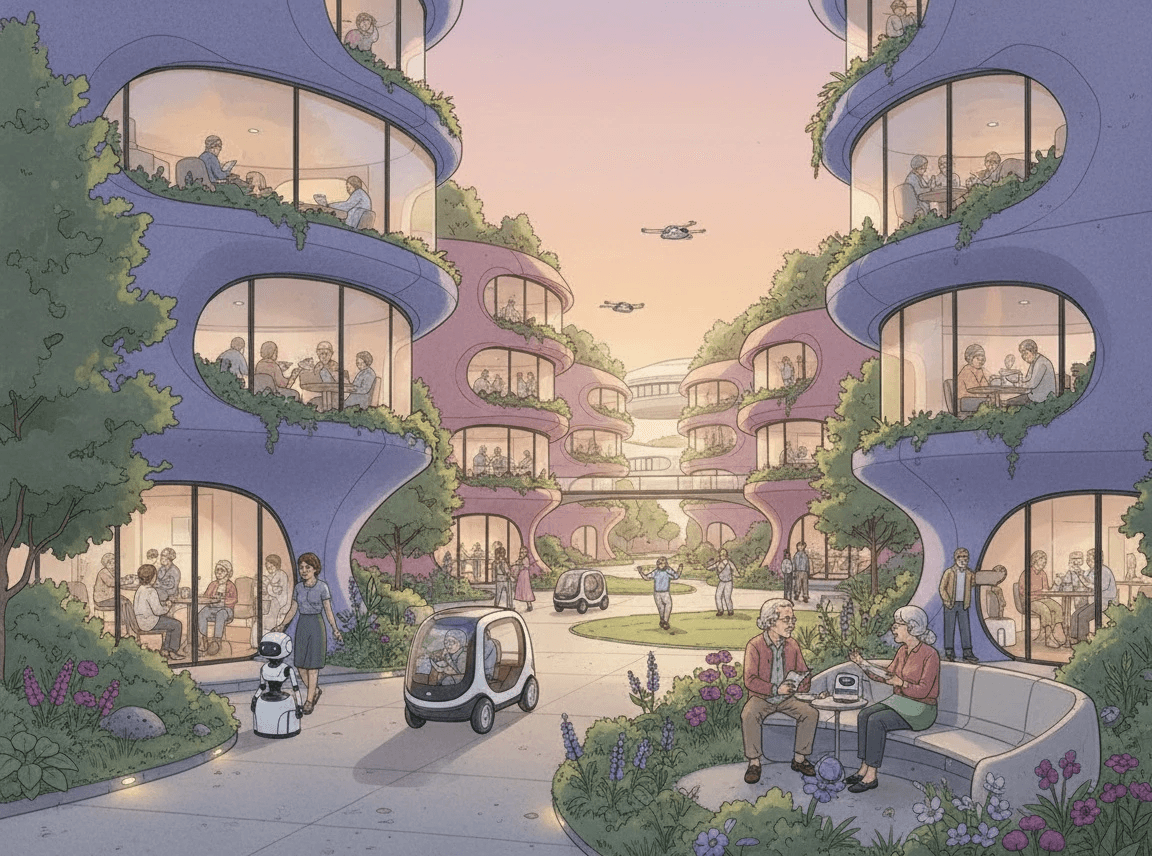
In terms of neighborhoods and living spaces, I see the following developments: Remote work, automated services and digital infrastructure have eased some of the pressure on some cities and conurbations. Digital centralization has led to a kind of physical decentralization. It has also meant that many peripheral areas - small towns, rural regions - have gained new importance because young families in particular are moving there (again). For reasons of cost, space, the desire for more nature or a sense of home.
New forms of living such as co-living models, intergenerational communities or hybrid spaces that combine living, working and socializing are becoming increasingly common, especially in cities. Digital platforms are helping to organize and moderate these real-digital networks. The term “neighborhood” is being redefined - not only as a spatial, but also as a digital and social affiliation.
A: Do you think that modern cities are future-prepared? What is the basic preparation that you would recommend that every city must have in place?
C: It is fundamentally important to think more systemically when it comes to urban planning and neighborhood development, simply because we are dealing with increasing complexity and ambiguity today and in the future.
In relation to different groups of people and lifestyles, in relation to climate change and mobility issues. That's why silo thinking and acting is a thing of the past. In order to be able to deal with this complex future, different disciplines - politics, business, science, art, but also the citizens themselves - must cooperate and exchange ideas.
This also means that there is no longer a one-size-fits-all solution for all cities. Every city is a unique combination of its environment, architecture and infrastructure, as well as its current and potential future inhabitants.
Nevertheless, there are a few basics, e.g.
Greenery and water against heat islands and for our senses
Smart infrastructure: intelligent energy and water management systems, multi-mobility
Cybersecurity: data protection and data transparency for citizens
Participatory: citizens help shape and identify even more strongly with the city
The good, the true and the beautiful: art in public spaces
The city of the future is an aesthetic as well as functional living space that provides answers to the needs of its residents, but also surprises and challenges them.
A: We have seen how the social networks enabled us to connect with each other, while capitalising on our relationships, by selling our attention. We observe that AI does not act as a mediator connecting us with people but rather, is quite ready to replace our relationships, commercial and even personal bonds. We already don't need a translator, but soon we won't need a lawyer, a videographer and even a partner or a friend. How do you see our future social and professional connections evolving?
C: This is where the really exciting and worrying part begins. While social networks have scaled our relationships, AI is starting to replace them. Chatbots, virtual companions, AI-supported services: Much of what used to be relationship is becoming a simulation of relationship. I'm rather hopeful by nature, but to be honest, there are already chasms opening up here.
AI as a coach, therapist, conversation partner and even love partner, that is functional and/or highly dehumanizing. It unerringly misses the point of what is actually meant by life. The unexpected, sometimes painful, fragile, beautiful and vibrant.
I strongly advocate that we learn to endure life again and to overcome the micro- (or macro-) crises of our everyday lives again and again. Even talk to the annoying neighbor or the colleague we don't like. ...
I strongly advocate a new wave of creativity, empathy and narrative skills. We don't just need people who operate AI, but people who renegotiate meaning in an AI-supported world.